Wednesday, July 20, 2011

Hello, and welcome to The Snowball Effect, the blog that acts as the magical rainbow conduit between your brain and mine. I, CommanderSnowball, am your guide through this wonderful world of giant turtles, philosophical chests-of-drawers, and the occasional belligerent chamber pot.

So today's edition of The Snowball Effect is going to be a bit different. Remember those book reviews I did of The Great Gatsby and Brave New World? Well...we're not going to be doing that exactly today...today's going to be just me ranting about something that's been on my mind. Hopefully you guys will enjoy it!

Right, so the topic on my mind is one that's been circulating for a while now--Harry Potter vs. Twilight. DUN DUN DUUUUUNNNN! Yes, I know it's a touchy subject, and you're free to argue among yourselves about it, but this is my honest and unblemished opinion on the subject.

I've read Harry Potter for years, ever since Goblet of Fire, and because of this, I may play the part of the angry fanboy who just rages at anybody who says Harry Potter sucks. That being said, I honestly and objectively think that Harry Potter is, at the end of the day, a good series. Here's some of the things that I like about it: First off, it's got great character development. You've got Harry, who goes through all levels of the snot-nosed, whiny, Luke Skywalker-esque personality to eventually become a hero who has other people's best interests at heart; you've got Ron, who basically undergoes the same change into a brave young man; you've got Hermione, who goes from upturned-nose, "I'm-better-than-you-because-I'm-super-smart-and-I'm-the-personage-of-the-feminist-nature-that-naturally-resides-in-most-young-girls" Hermione to "I'll-stick-by-my-friends-because-I'd-be-horribly-screwed-if-it-weren't-for-them-and-I-kind-of-sort-of-maybe-like-hanging-out-with-them" Hermione; you've got Draco, who at the beginning of the series is a stuck-up brat, and at the end is still kind of a stuck-up brat but you realize that he was under loads of pressure the whole time so it's okay; you've got my favorite character, Neville, who takes a complete 180 from "so sorry for myself because my mum and dad are vegetables" to "what the heck did you just call me, giant spider"--the list goes on and on.

So, excellent character development is one reason.

Secondly, there's a definitive battle between good and evil, a line that's kind of hard to draw in Twilight, which I'll talk about in a moment. In Harry Potter, you can usually tell the difference between a good wizard and an evil wizard. Namely, most of the good wizards (the Aurors {for the most part, anyway} and the Order) are trying to protect Harry and the bad wizards (Death Eaters and their entourage) are trying to kill Harry. Kind of like a magical game of football, except only one person is allowed to score, and the only way you can prevent him from scoring is to kill him. With wands. And giants. So, actually, nothing like football.

Thirdly, the writing is pretty good (after the fourth book). She puts great detail into every scene, even ones that aren't ultimately important to the plot, because Rowling knows what every good writer does: EVERY SCENE IN A GOOD BOOK HAS SOME UNDERLYING PURPOSE TO IT. This is why you can spend hours picking apart The Grapes of Wrath or To Kill a Mockingbird or Huckleberry Finn in your AP English class--because, quite literally, every scene can have a good two or three layers of significance to them. Now, whether or not every one of those layers actually exists and/or needs to be expounded upon is a subject for another blog post. ;)

So, I'm limiting what I like to three things: Excellent character development, difference between good and evil and a struggle between the two, and good writing technique (for the most part). The one complaint I might have about Harry Potter is that the first three books are undeniably kids books. They were written with kids in mind, and as such, they are not very good books. Sorry, they just aren't. The first two movies are pretty good, but the books aren't.


So...Twilight...

I've never actually read Twilight, but I did listen to a guy on YouTube read through the first book, which was probably the most fun I've had making fun of a book aside from freshman English. As such, you should take my opinion with a bit of salt; however, I do mean what I say.

Okay, so basically the whole premise of Twilight is that this girl meets a guy who happens to be a vampire and she falls in love with him and he protects her from all sorts of catastrophes and she has to make up her mind about whether or not she wants to spend the rest of her life with him. Meanwhile, things are pretty much literally going to hell around them as vampires come streaming out of the woodwork and the "good" vampires (???) and werewolves (???????) try to fight them off. Correct me if I'm wrong, but from what I've seen of the movies (which, admittedly, is the two-minute long trailers that keep getting shoved in my face), that seems to be the gist of it.

Right. First off--the characters suck. The two most notable characters, Edward and Bella, are stupid. Mainly Bella is the stupid one, but Edward's kind of a soppy, sentimental idiot as well. Plus, "good vampires"? Good vampires!? Really? Basically, you've just taken a creature whose sole purpose is to kill us all and drink our blood, and you've given it a sense of morality and the sanctity of human life, which is impossible. If a creature needs to drink human blood to survive, chances are it's probably not going to view us as creatures whose lives are valuable as anything other than a food source. Certainly not a life companion.

But back to the stupidness of the characters--in the first book, Meyer says pretty much nothing about Bella except that she whines a lot about everything and is incredibly self-centered. Which, to be fair, is how a lot of good characters start. For instance, Ron Weasley--he was incredibly self-centered at first. And Edmund from The Chronicles of Narnia--the ultimate brat (not to mention, of course, Eustace, from the same series). But in all these other books, a definite change ultimately takes place in these characters. Again, I haven't read the Twilight series, but from what I see from the movies, she's just as self-centered and hormone-driven as she was in the first book.

Second--the point of the book is not the battle between "good" and "evil", if a distinction between the two even applies here. The main focus of the book is on the relationship between Bella and Edward, and later, between Bella and Jacob. The problem is that their relationship is UTTER GARBAGE!!!!! Honestly, when you read it, it's the most uninteresting, unimaginative drivel you could imagine. It's so horribly corny. It's like Romeo and Juliet level of corny, except Shakespeare had the excuse of being the first person to come up with it, not to mention that Shakespeare was actually an awesome writer. Stephanie Meyer is just plain bad. Seriously. Her writing is painfully awkward, there's just no way to splice it.

Finally (I know, this is getting kind of long), it would seem from my limited exposure to the books that Bella's main purpose is to worship Edward. Now, I have even more limited experience with relationships than I do with Twilight, but I will say that any relationship where one person is worshiping the other is always going to be unhealthy for both sides. Plain and simple. Sadly, I see too many young girls that actually think this is the way love works, and I'm starting to think that maybe Twilight is the reason. Because let's face it--it's much simpler to blindly devote yourself to a person than to actually reason with yourself about loving them. It's much easier, and I think that appeals to a lot of people.

In conclusion, the answer to the question of Harry Potter vs. Twilight is "Harry Potter, without question". At least in Harry Potter you have some good characters and role models, whereas I'm not seeing anything of the sort in Twilight.

This whole thing has got me rather interested, to say the least...I might actually pick up a copy of the last book of Twilight, just to see what it's like. Anyway, I'll keep you posted if my opinion changes.

Oh, I should probably put up something funny to reward you for reading all the way through this.

:D

Until next time,

--CommanderSnowball

Tuesday, July 19, 2011

Book Review! "Brave New World," by Aldous Huxley (7.19.11)

Hello, and Welcome to the Snowball Effect! Glad you decided to spend a little bit of your free time and energy reading this!

Since last week you guys seemed to enjoy the book review over the Great Gatsby, I thought I'd do another one just to see how it goes. So, without further ado, here's a review over one of the books I read this summer from a recommendation by my English teacher--Aldous Huxley's Brave New World.

The setting of Brave New World is pretty easy to understand once you get into the story a bit--basically, mankind has progressed scientifically to the point where we have scientific solutions to all our problems, including the consequences of our actions, a predicament which naturally leads to the society that you see in Brave New World--a society of lustful, drug-dependent automatons in a caste society who are all remarkably content with their lifestyle. The story is basically about a man who becomes disillusioned with "civilization" and goes to an Indian reservation in America, where he finds the forbidden half-breed son of his boss living a squalid life of self-inflicted, pious pain. He brings the half-breed, who is known to everyone else as Mr. Savage, which is quite possibly the coolest name ever, to "civilization", whereupon my narrative ends, and if you want to know anything else about the actual plot of the book, you'll have to (merciful heavens, no!) read the book yourself.

Hereupon begins my opinions about the book; feel free to voice your own through any medium you wish, bearing in mind, of course, that this is, for the most part, subjective stuff.

According to the standard Evolutionist school of thought, all creatures are constantly evolving to become better beings, a principle which states, in fact, the entire point of evolution. That's why, according to the history of an evolutionist, fish grew legs--because they would benefit from it. The point of Brave New World is that, eventually, humans will learn enough science to solve all of our problems and create a sort of terrestrial Paradise. The only problem is that, as illustrated in Huxley's novel, when we get to that point, we lose what makes us human.

You see, when we are faced with the choice to do something good or to do something bad (or, in most cases, to not do something bad, which is the good choice), we go through a mostly-unconscious thought process. Basically, our human brain is having a staring match with our conscience. The conscience says, "You shouldn't do this because A) It will cause bad things to happen to you later on, B) God says not to, and C) In the long run, it will improve your relationship with the people to not care about if you don't do it; and then your brain says, "Want want want want want want want," which, of course, is not a reason. The problem is, once one get to where things are in Brave New World, all of a sudden things are on a completely different playing field.


Now when one are faced with a decision, the conscience goes to the three big reasons one shouldn't do it. But the brain goes, "A) No it won't, because science fixed those problems, B) Humans have solved all problems, therefore we have killed God, who is, to an atheist, basically a metaphysical policeman, and C) Solved it with genetic engineering and brainwashing, man." To which the conscience replies, "Well, you really shouldn't," to which the brain replies, "But I want to," at which point the conscience shrugs its shoulders and buys both of them their drinks. To summarize, the atheistic viewpoint states that the only thing stopping you from doing what you want is your common sense, which looks into the future and figures out what the consequences are for your actions. Thus, if and when science can negate those consequences, the possibilities are, quite literally, limitless.

For those of you who are bored, confused, or are just here to see something funny, here's Homer Simpson tripping over and over again.

 Now this kind of situation (back to Brave New World) is perfectly okay as long as God isn't around to mess things up. You see, our morality is depended upon a source outside of ourselves, which is why we can objectively evaluate the "rightness" or "wrongness" of a given thought, action, or philosophy.

But that's not the point of Brave New World, sadly.

The point of Brave New World is actually similar to that. The main focus of the book, it would seem, is that by "evolving" ourselves to the point where we no longer need to strive to live, we actually become more base creatures. Our thought process goes completely down the drain, we lose contact with emotions, and we basically become self-serving animals. We become animals in a proverbial zoo--all we really do is please ourselves.

Don't get me wrong--I'm not belittling God's influence in any way. It's just that this is a review of Brave New World, and the book itself does not include God as a factor. I think that Huxley certainly includes the idea of God as a factor--in other words, that mankind has an innate feeling that there's somebody bigger than us all keeping tabs on our actions--but I don't think he understood or was attempting to communicate that God is in ultimate control.

So should you read Brave New World? I don't know...do you like science? Do you like drama? Do you like confusing stories of romance? Do you like picking apart the human psyche? If so, then yes, I think you would enjoy Brave New World. My verdict? Brave New World is a very well written, Orwellian-esque epic of the battle between our desires and our own good, and of the contrast between the world inside the bubble of security and the world outside it.

Well, that about does it for me today. At this time I'd like to remind you to please give me any feedback you can through any medium you need (that means I'll read stuff you tell me on Facebook). So, please give me any feedback you can through any medium you need!

Until next time,

--CommanderSnowball

Indeed.

Saturday, July 16, 2011

VBS BLOG!!! (7.16.11)

Hello, and welcome to The Snowball Effect, the blog where you, the reader, are transported into a magical land of ponies, helicopters, and bad puns!* I am your guide, CommanderSnowball, but you can just call me Snowball if you want, or if you can call me Kyle, which is my actual name.

Either way, WELCOME TO THE JUNGLE!!!! I'm so glad you're reading this! If you could take a quick moment to leave a nice "liked it" rating down below, I'd really appreciate the support! Or not, that's fine. It only speaks about how horrible of a person you are. :)

This week, I helped out a lot in story time in VBS at my church. We had a lot of fun making sets for the kids and leading them into some pretty cool stories. My favorite night by far was Jonah and the whale, when we actually made a giant whale out of black plastic and inflated it with fans and let the kids crawl inside of it.

Basically, we put the kids in a giant trash bag. We also gave them plastic bags to put over their heads and called them jellyfish. I'm kidding, of course, but let's just keep that a secret between us, okay? wink wink


Anyway, that was really the best night of them all as far as skits went. But that's getting a bit off subject--let's get back to my reason for making this blog, which is to elaborate on the five points that were taught in VBS this year. For those of you who don't do Vacation Bible School, or just don't remember it all that well from when you were kids, there are usually five biblical truths taught during VBS, one for each day. They're usually kept very simple, so all ages of kids can understand them, and part of our job at the Bible Story station is to emphasize those points through Bible Stories. Obviously.

So, without further ado, let's get started!

Day 1's theme was God made you, which we illustrated by making a "Creation" room and letting the kids experience the days of Creation by putting on costumes and doing little crafts that illustrated some of the days of Creation. We had the whole place lined with black tarp to symbolize that, in the beginning, there was nothing. Just thinking about that gives me chills down my spine--to think that there was absolutely nothing, only God. And then to think that He created everything--He spoke, and the world came into being. That's how fast it was--that's how powerful God is! Just a few words, and life in all its complexities comes into being.

Day 2 was God Listens to You. This was emphasized by the story of Elijah confronting the prophets of Baal on Mt. Carmel. Remember that story, when God sent fire down from Heaven and it burned up the soaked offering? Yeah, we got to do that, except we didn't burn any offerings. A fireman (yours truly) stopped anybody from setting any fires, although one of the leaders said that one time, at his old church, when they had done this story at VBS, the last thing they poured on the offering was alcohol, so that it actually did light up. Now that's pretty smart.

Anyway, if you think about it, Elijah must have been pretty faithful in God that day. I mean, if nothing had happened, he would have been the laughingstock of the entire nation! But he trusted in God, and God answered his prayers. It just makes you think of how awesome God is, doesn't it? To think that after all those years of His people turning away from Him, He just comes right back at 'em and says, "Oh, hey there. Remember me? The really powerful guy who defeated the Egyptians for you? The guy who knocked down the walls of Jericho for you? Yeah...I'm still here." Only, instead of saying that, he sends down a giant pillar of flame and scorches an offering. Yeah. Power. Loads of the stuff.

Day 3 was God watches over you. By far one of my favorite nights, on Day 3 we created the aforementioned giant whale and Jonah (again, yours truly) got sucked into the whale and then "urped" out.

No, I'm not trying to be funny. The script actually says, "The whale 'urped' Jonah out onto the beach."

I'm sure that removing the "b" from the word "burped" is going to please the soccer moms who no doubt were outraged years ago that a previous Jonah retelling had such a rude word as "burped" in it. God forbid we should let our kids use such foul and brazen vocabulary.**

Oh, before I forget...for those of you who are bored, I'm sorry. Here's a funny picture.


Anywhoosles, I think the kids really enjoyed Day 3, mostly because of the crawling into the whale and the whole hands-on-ness of it. Again, it just makes you think about how awesome God is--He told Jonah, one of His prophets, to go somewhere, and Jonah ran away. God could have easily let Jonah die and found someone else, but He didn't! He sent a storm to wash Jonah overboard so Jonah could get swallowed by the whale (big fish, I know, but since the kids already think it's a whale, we just thought we'd humor them) so Jonah could realize that God was watching over him and he could be thankful and go to Ninevah! God watches over us, but He's doing more than just watching! He's protecting us, too! That's rad!

Day 4 was probably the best night of them all. The theme was God loves you, no matter what. We illustrated this by going down into the basement area of our church and pretending it was a secret place where we were hiding from the Roman soldiers. Then Peter (I've had so many parts over this week, I don't even know who I am anymore) came out from another entrance and told the story of how he betrayed Christ, and the kids tried to tell him that God loved him no matter what. After that, the kids had some pretty good group discussion on the subject of letting God down and how He forgives us even after all that. I've gotta tell you, it effected even me that night, just from thinking about it.

Day 5 was God gives good gifts, and our story was about Hannah giving baby Samuel back to God. This was a lot of fun to do, because we actually had a "baby Samuel", which was the three-year-old son of one of the ladies helping us, Amy Stouffer. I had a lot of fun playing with "Samuel" during the breaks; it was kind of refreshing to see the pure, unbridled joy in a kid's face again. It reminded me of a simpler time, when all of my worries were about the now, and they were gone in a fleeting moment; when all my troubles could be solved by a kiss from Mommy or a pat on the shoulder from Daddy; when, in an instant, my boredom could be solved with a ball of Playdoh and a balloon. I kind of miss those days.

*sniff

...uh, I wasn't being sentimental! *hides tissues* I was just...um...I had...I had something in my eye. Yeah, that's it. Just...something in my eye...

Moving on!

We were talking in the "break room" (aka the-room-right-next-to-the-story-room-where-we-hang-out-between-breaks-and-it's-kind-of-like-back-stage-except-not-really) about how Hannah must have been a really faithful and righteous woman to give her child back to God. I'm no father (thank goodness), but I can hazard a guess as to how hard it would be to give my only son back to God, especially when I went through such hardships as Hannah to get it.

Speaking of which, did you know that Elkanah (Hannah's husband) had two wives, and his other wife, Peninah, had many more children than Hannah? It's true! And Elkanah gave Peninah more food than Hannah because she had more children to feed. Which makes sense from a practical standpoint, but from an emotional perspective, the pressure of favorites must have been so hard on Hannah.

Of course, this whole problem could have been solved if Elkanah was actually a God-fearing man and didn't practice polygamy.

So many problems could be solved if certain people were just never allowed to breed, ya know?

Anyway, that's all of the stuff we did and all the points we tried to make to the kids. Hope you enjoyed this blog! Please comment and tell me what you think about this blog--I really do appreciate any feedback available! It doesn't have to be a whole paragraph or anything--just little suggestions if you want! :D

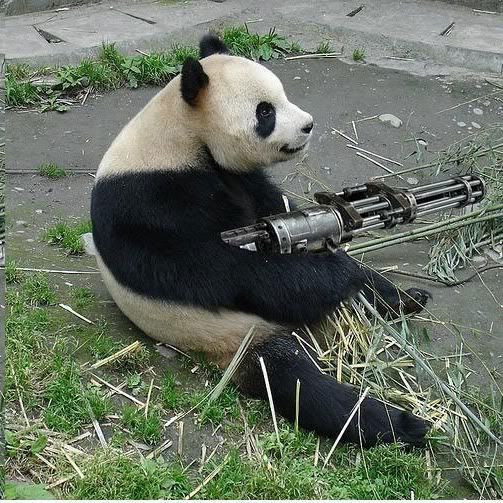
For those of you who just wanted to see something cute or funny, here's a panda:


I guess you could say he's causing....PANDAMONIUM!

Told you there'd be bad puns!

Until next time,

--CommanderSnowball

*Helicopters and ponies are, sadly, not included in this package; however, keep your hopes up!

**I'm not actually saying that such a thing happened. I'm just making a point--some parents are a bit overprotective of their kids when it comes to this kind of stuff. I'm no parent (thank God) but as a kid I know that there's nothing more embarrassing than, say, being the only kid in his class who hasn't seen Harry Potter because his parents are overprotective nuts who think that just because it has magic in it that automatically makes it satanic of origin. Heck, The Chronicles of Narnia had magic in it, and blatantly so--it even called it the Deep Magic, or whatever the heck it was, and the Chronicles of Narnia is literally an allegory of Christianity.

Friday, July 15, 2011

What Exactly is Greatness? (7.15.11)

Hello, and welcome to the Snowball Effect, the place where anything can happen!

Well, not really. But we like to pretend. 'Cause we've got...


IMAGINAAAAATION!

Anywhoosles, I thought I'd make today's blog about something that I was thinking about last night. Here it goes--enjoy!

When you look at all the so-called "great" people in the world, you wonder what makes them great, right? Because deep down, each one of us wants to matter. We want to be famous; we want to be important. In the words of Colin Singleton, we want to matter. We want to step over the line between "prodigy" and "genius" (if you don't understand why I used the words "prodigy" and "genius", or for that matter, don't know who Colin Singleton is, I suggest you read An Abundance of Katherines, by John Green. While you're at it, go ahead and read his other books, too--they're just as entertaining, if not more so.) The driving force of humanity, the very reason we build houses and get jobs and take laborious amounts of college classes and work nine-hour jobs and drive cool cars and found new countries and find cures for new diseases and write really good books and make really good movies, the reason for ALL THIS is that at one point in history, humans were perfect beings!


My theory is that maybe, deep down, people want to get back to the perfection that we once had, before we screwed everything up, by doing stuff that leaves an impact, be it a cool movie or an impressive building or money for our kids or whatever. But that same driving force is also why many people try to "matter" by means of superficial things--like plastic surgery, who has the coolest car, and the "American Dream" aspects.

The question that is posed, then, is quite simple, yet also deeply complicated and rooted in philosophical and theological backgrounds--what does it take to be great? Or, more concisely, what is greatness?

Don't worry, this is not one of those questions that has no answer, like all those rhetorical questions your parents would ask you after you did something really bad, such as "Why did you do it?", when the only answer you can truthfully give is, "I don't know," because, let's face it, when you're that age, you do something either because your parents told you to, or as a spasmodic reaction to stimuli including, but not entirely limited to, peer pressure and chocolate.

Although, I could say, "I don't know," and then I wouldn't have to write anymore.

....naaah, this is fun. Let's keep going.

So--greatness. What is it?

Well, greatness is two parts, conveniently enough. Part One is about what you do, and Part Two is about how you do Part One.

Part One: The first thing I'd like to say is that Teddy Roosevelt was wrong. Wrong, wrong, indubitably wrong. First off, nobody's born great, and if you think you were born great, you're suffering from the delusional self-elevation that plagues a lot of movie stars and musicians nowadays. Those people aren't great, they're just really good at what they do and they know it. Secondly, greatness is not "thrust upon you" like some gift. True, sometimes you get opportunities to become somebody more than you are, but these work differently than gifts.

You see, when you get a gift, you don't have to work for it, hence the fact that even bad children get gifts on Christmas and you don't have to really do anything to be Saved. (not that you can do whatever you want once you're saved, just that you don't have to, like, cut off your right arm and sacrifice it along with your firstborn son and your prized, autographed John Mayer CD or anything silly like that) However, when you get an opportunity to be great, you're not just rich and famous and that's it. I mean, look at Bill Cosby--he had to work his butt off every single day just to get noticed by people. Look at such internet phenomenons like ShayCarl and Phillip DeFranco--they didn't get famous just by sitting around with a camera all day. They had to come up with entertaining material, film it possibly several times, edit the videos...lots of work for very little reward. But when you work for a really long time at something, no matter what it is, eventually your hard work pays off for something.

My point is that even if "greatness" is literally just given to you, like you're the child of a business tycoon or something, you still have to work hard to be successful. That's the cool thing about America--in theory, anybody with the talent and the moxie can become anything they want to be, because we have the freedom to decide what we want our lives to look like.

So, Part One: Greatness isn't just inherited, effort is required for it.

Part Two: I remember reading a portion of Douglas Adams' The Hitchhiker's Guide to the Galaxy, wherein the following quote was found--"It is an odd coincidence that the people who don't want to be Galactic President are those who are the most qualified for that position, and those who want it the most are most often the least qualified." (sorry, Other Kyle, I butchered that quote, but the sentiment remains) The point is that those people who actively think they are great and flaunt it around are the people who really aren't great, they're usually just really good at something or they've got an ego just a little bit smaller than that of Zaphod Beeblebrox.

I'd also like to point out that many truly great people we admire are, indeed, human. The movie stars that you adore, the musicians you listen to, the people you idolize, they go home every day to live regular lives. The greatest people in the world have always had a connection with the simple things in life--the regular, non-glamorous lifestyle that we all tend to think is restricted to us middle-class, regular people is actually the life of many great people.

Finally, I'd like to add that these "great things" that you do, they affect everybody around you. Just think of all the changes to society, for instance, that were brought about by the Beatles--everything changed! Music, philosophy, education, the Hippie movement, those things were started in part because of the influence of five British guys. Now, before you go talking about how the Beatles were druggies and not all of the changes they brought were good, I'll prove you right by saying that the fields of philosophy and (the will for) education have degraded horribly (for the most part) since that era. This is why you need to make sure that what you're doing is actually going to benefit the people you are influencing in the long run. Is the philosophy you're putting out there really on par with the morals and values of a God-fearing Christian? Because in the future, it's really going to matter for the people that were influenced by you and your actions.

True greatness, therefore, can be described as doing things that will influence other people with an attitude of humility, respect, love, and gratitude. In a more concise manner of speaking (excluding, of course, the attitude required to be great), greatness is making other people's lives better in the long run.

Anyway, that's all I have to say today. Sorry this blog was late, I literally had no time whatsoever yesterday to get this done.

I feel like I've been entirely too serious, so I'll give you a picture of a puppy:


You're welcome. :)

Until next time,

--CommanderSnowball

Tuesday, July 12, 2011

I'M BAAAAAAAACK! (7.12.11)

WELCOME TO THE--

WHOops! Forgot to turn off the Caps Lock after the title...silly me...

Anyway, Hello! And Welcome to The Snowball Effect! I've been gone for a while, due to "holiday" and other sundry things, such as being rather comatose for the past few days from my wisdom teeth being removed, so all the material you guys would get would mostly be in the form of "ahhh, ah ahh aah, huh nuh nuh, ahw". Which I'm sure no one wants to hear.

Anywhoosles, I figured today I'd do a little book review, since I spent a good part of my holiday reading. A couple of the books I read while on holiday were The Grapes of Wrath, All Quiet on the Western Front, and The Great Gatsby. I read Grapes of Wrath and the Western Front because they were summer reading, but I read The Great Gatsby because, well, because a friend of mine whose opinion I value very much said she hated it, and I wanted to see if I could figure out why she hated it. I'm not sure why she hates it so much, but I think I'll do my own little review over Fitzgerald's work--

Hold it! My Easy Listening playlist just switched to my favorite song! SPIN DOCTORS!! WOOOOOOO!!!!

(Watch while listening to Jimmy Olsen's Blues by the Spin Doctors from the link above to get the full effect. ;)
....whew...out of shape...*breathes heavily*.

Okay, back to the book review, self...

Great Gatsby. Okay. So.

As far as plot goes, the sequence of events is a confusing myriad of--FIGHT FI-YAH! WITH FI-YAH!

Sorry, I'll turn that off...

As far as plot goes, the sequence of events is a confusing myriad of coincidences and mishaps that is almost as bland and brainless as that of Glee and other such "reality" shows. In my case, I had to restrain myself from shouting profanities at the various vacuous characters who wander aimlessly through their suburban lives only concerned with fulfilling their base desires for late night companionship and a good shot of bourbon. It is such inconceivable lack of foresight that leads most of the characters to some pretty sad points in their lives. I found myself groaning every time Gatsby and Daisy met, knowing that nothing good could come of it, but also knowing that Gatsby was too thickheaded to see that.


Also, there is no clear distinction between good and bad, a quality that is refreshing after reading so many novels where such a distinction is the main point of the story, and where the author goes so far as to provide two easily distinguishable forces (such as orcs, for bad, and humans for good, for example, a dichotomy that I never understood, as a matter of fact--why isn't there a book about a clan of kindly orcs that are conservationalists or something, and they have to fight back to keep their...swamp pits, or whatever, from the greedy humans? Food for thought...or maybe it's just the paint fumes wafting up from the basement getting the better of me. back to the review) that meet in an epic struggle. In The Great Gatsby, there's no clear protagonist or antagonist--actually, now that I think about it, pretty much everybody in that book is an antagonist to someone, but there's no real protagonist. To put it another way, there's a lot of Darth Vaders in The Great Gatsby--but wait, I can't think of anybody who's actually evil in that book. Okay, there's a lot of Sandman's in The Great Gatsby--people who's manner of living is dying slowly--but there's no Spiderman to set 'em right.

And you know what? I kinda like that.

Because you see, that's a pretty accurate portrayal of the way we are as humans. It's what riches and good times does to our brains--we begin to forget about the future, our brain cells start getting out of shape, and our logic just goes down the drain. It's what this new generation of Christians is starting to call "going through the motions"--forgetting that there's a reason for it all, or in the case of The Great Gatsby, not having a reason to begin with.

You see, when we're in extreme poverty, where we have a major lack of something we actually need to not die, we go into a persona that I like to call "The Analyst". It's the little guy in your brain that keeps tabs on everything you do and runs risk-benefit analyses taking temporary control. Kind of like Senator Palpatine taking temporary control of the Republic, except, of course, very few people turn into psychological personifications of the Galactic Empire, which would be quite the interesting psychosis, might I add. As The Analyst, we become incredibly concerned and devoted to getting the one thing we need to survive (e.g., food).

What's that? Okay...fine. The cynical part of me would like to point out that the root word of analytic (in the sense of personalities) is anal (also referring to personality). I know, I'm a sick person. Deal with it. :)

Anyway, The Analyst is concerned about getting, for example, food to survive. But people who are accustomed to good times, such as the 20's, go into a more relaxed mode. This is the middle-class American psychosis--all the basic needs can be met with minimal effort, leaving more time for relaxation and recreation. Once our survival is assured, we tend to stop thinking too deeply about our day-to-day decisions, which can become dangerous. In The Great Gatsby, it leads to two ruined relationships, two dead lovers (though each others), and an empty, quiet house and lawn, where drained bottles of cheap wine and the burned-out stubs of cigarettes and cigars are all that's left of that wonderful, fleeting era of fast living and slow dancing, of cheesy jokes and sultry smiles, and of a thin layer of metaphorical cellophane separating it all from the real world, where Fate smiles cruelly on the rich and poor alike.

To summarize: My opinion is that The Great Gatsby clearly represents through the characters' nearsightedness and lack of morals the affect of good times on the human psyche, and the consequences of such.

That's my two bits on The Great Gatsby for you. Like it if you do, disagree if you don't, but above all remember this--WE DIDN'T START THE FIRE! IT WAS ALWAYS BURNIN' SINCE THE WORLD'S BEEN TURNIN'!

....oh, Billy Joel...you put everything so well.

Until next time,

--CommanderSnowball

Monday, June 20, 2011

ATTENTION!

Sorry I didn't put up a post yesterday. As it was Father's Day, I figured it would be better for me to spend the whole day with Dad rather than sit in front of a computer all day. I hope you all did the same...and Happy Belated Father's Day, everyone!

I will be gone until July on vacation, so don't expect any blog posts for a while. Until then, cheers!

--CS

Thursday, June 16, 2011

6-16-2011 "IGNORANCE IS FUTILE!"

Hello, and welcome to the Snowball Effect, the blog where magic happens!

Actually, not really. But that would be cool!

So I wasn't really having fun with looking up news articles and stuff, because a lot of the news is generally the same stuff, to be quite honest (people getting killed, people in prison, countries getting mad at each other, etc.), and I didn't find it all that interesting or enjoyable.

So I think Thursdays are going to be days much like Tuesdays, except decidedly less random. Still funny, but less random.

So today's blog

--WAIT! Hold it! Carl Parkman from the Grammar Nazis here, we've had a report that you've used the word "so" to start too many paragraphs in your blog! Boring sentence structures are against regulations!

Hang on a moment...you just joined two sentences without a conjunction, and you're saying I'm the bad grammarian?

.....curses. Very well...you win this round, Snowball! BUT NOT THE WAR!

...I'm very sorry about that. He tends to get a bit annoying at times.

Anyway, today's blog is about a series of questions asked by a certain "JesusFreak" on Facebook (not me, by the way) to, "Any Young Earth Creationist". These weren't very coherent or sensible questions, as you'll no doubt see in a second, but I did my best to answer these nitpicking, nonsensical queries.

Here's the questions:


  1. The Genesis flood: Where did all that water come from? Where did it go?
  2. How could the Genesis flood form the Grand Canyon? more information on the Grand Canyon
  3. How do you explain the universally consistent radioactive dating results obtained with different radioactive elements, and the consistent correlation with objects of known age?
  4. What scientifically factual information can you supply to support your contention that the universe is only a few thousand years old?
  5. How do you explain the astronomical evidence that the universe is billions of years old, without resorting to the preposterous assumption that the speed of light was millions of times faster in the past than it is now? more information
  6. What mathematical proof can you supply, based on the known equations of thermodynamics, that order can not spontaneously arise from disorder? more thermodynamics information
  7. If your claim that thermodynamics will not permit the evolution of complex living structures is true, then how do you explain, without resorting to make-believe special mechanisms that have no basis in thermodynamics, the development of a chick in an egg?
  8. If creationism is scientifically valid, then why is it necessary to emphasize that the sectarian religous dogma of the Book of Genesis is the ultimate scientific authority?
  9. If you believe that God can override nature to create living things as described in the Book of Genesis, then what reasons do you have, other than your religious beliefs, that God could not have created living things through a process of evolution?
  10. The standard creationist explanation for the distribution of fossils in geological strata, with most primitive life forms in the lower strata, and mammals and humans in the upper strata, is that clever mankind was smart enough to climb to higher ground to escape the rising flood waters. How do you explain the fact that thousands of persons drowned in the recent Central America floods, in an area contiguous to higher ground? How do you explain the position of the fossils in the geologic layers, with small fossils below large fossils, which is contrary to hydraulic sorting in which large objects settle deeper than small objects?
And here's my response:

  1.       Some theories suggest the water came from a canopy, or layer of water, suspended (probably via gravity) above the Earth’s atmosphere. (Genesis 1:6-8) Also, water came out of the “floodgates of heaven” (i.e., a canopy) and the “springs of the great deep”. As for where it went, all the Bible says is that the water receded. Those exact words. (Genesis 8, pretty hard to miss) I believe that God has the power to just make the water disappear. I mean, He created the universe, for Pete’s sake—I think He can handle a little cleanup.
  2.       Erosion. Lots of erosion. Think about how much water there was—LOTS OF IT. We’re talking miles of the stuff—enough to cause some serious amounts of pressure. And when the stuff starts draining away, it pulls the rocks and soil and stuff with it. Now, I don’t pretend to be an expert on erosion—heck, I’m no scientist—but it doesn’t take a geologist to figure out that the waters caused by the Flood would be enough to erode on a Grand Canyon level.
  3.       I don’t know if you’ve realized this, but those dating methods aren’t very exact, nor are they very accurate. Before you argue that they are not so, bear in mind that it’s still a guess, and guesses aren’t surefire ways of saying, “You’re wrong, I’m right.” The only way we can know objective truth is if it’s found in the Bible OR it’s proven by multiple scientific experiments. And by multiple I mean more than you think. And if the answer that science gets is different than the answer that the Bible gives, then science is wrong and God is right, end of story.
  4.      I hate to answer questions with questions, but why is science the ultimate answer to you? If you really are a “Jesus Freak”, then shouldn’t the Bible be the ultimate answer? But in any case…the answer to this is quite simple. Based on the current rate that the universe is decaying, I’d say that it wouldn’t make much sense if it were more than a few thousand years old. Again, I’m no genius, but that’s how I see it from a scientific standpoint. Now, I could be wrong, and we could be sitting on a six billion year-old hunk of rock right now, but heck if I know any better.
  5.        What astronomical evidence? As far as I know, I’ve never heard of any logical evidence suggesting this. Please, enlighten me, as I would most certainly wish to hear your theories on the subject.
  6.        A) See #4. B) “can not” is one word: “cannot”. If you’re going to use the full forms of contractions, do it correctly. C) Second Law of Thermodynamics states, in dumbed-down form, “Entropy is always increasing,” or in other words, “Order is always decreasing”.  Ergo, if there is disorder (entropy), then it stands to reason that order CANNOT “spontaneously arise” from it.
  7.       Your question is invalid due to the assumption of my previous answer, but I’ll humor you anyway. The development of a chick in an egg is not evolution in the sense of change from one creature to another. The chick in the egg is still the same type of creature that its mother is. Once the chick has grown and comes out of the egg, it is still a chicken. It’s not a cow, it’s not a monkey, it’s not a rat—it’s a chicken, just like its parents.
  8.    Sectarian religious dogma? Are you sure you know exactly what that means? And also, what’s with the bigoted assumptions that whoever’s reading this is an uneducated, ignorant troll?
  9.       None. Although I do have to ask one question in return—if my religious beliefs aren’t part of the answer, then what the heck am I supposed to respond with?
  10.    I’m not joking when I say I laughed for about ten minutes straight after reading your “standard Creationist explanation”. That’s the biggest load of bull I’ve ever heard in the Creationism vs. Evolution debate. I’d also like to say that none of the rest of this question makes any sense at all. None of it. At all. Sorry, but I only answer questions that actually are relevant to the subject at hand. It’s a principle of mine.


Until next time,

-CommanderSnowball


A swashbuckling rogue, indeed.